Deadly Sins in Online Marketing
Instructions: How to successfully drive visitors away from a website !
You’ve painstakingly built your website, racked your brain endlessly over the content, and are offering visitors and your future customers exactly what they want—and yet these ungrateful jerks just bail right away? How is it possible that my website—which is sooo great—gets clicks, but not a single soul interacts with it in the slightest, and just because they don’t do anything, the whole thing isn’t working?!!
- Cookie Notice: Is it really necessary? And if so, does it have to take up three-quarters of the screen? You could incorporate it more discreetly! Or maybe find out whether this nonsense is actually required by law in Germany, or if it’s just something Google wants. There are people who don’t know what a cookie is and don’t want to know. But they know full well that you shouldn’t click on anything online that you don’t want to, so they just close the page—and that’s that.
- Pop-ups for newsletters and social media nonsense: You have a visitor who’s interested in your website’s content—who actually wants to read what you’ve written. And now you want to bug them with some stupid pop-up so they’ll sign up for a newsletter you’ll never write, and then once they’ve done that, they’re supposed to keep reading the text and, ideally, share this nonsense with their friends via yet another pop-up? Even you aren’t that stupid, so why should someone else do it?
- Automatically playing videos with sound: Imagine someone sitting in an office, twiddling their thumbs while getting paid a hefty salary… your future customer. They’ve secretly Googled your website, found it, and even clicked on it; now they want to browse quietly, unnoticed, and at their own pace—maybe even place an order… and you have the audacity to embed a video that automatically blasts at full volume. Your “ex-never-customer” isn’t going to look for the volume control; they’ll click away in embarrassment—and never come back!
- Social Media Buttons: You have an online store selling metal-clad fire pits, and on every product page there’s a button for Twitter, Google+, Facebook, Pinterest, Instagram, WhatsApp, and ideally Snapchat too. Seriously, who on earth is going to post a tea light—at 15 cents a piece—to their friends?!? Exactly, and that’s why you have to ask yourself whether this extra and unnecessary code on the website is really necessary, because…
- Load time: … unnecessary frills not only bloat the source code but also slow down the load time. 50% of internet users go online via mobile devices, and they actually use them on the go with slow connection speeds and limited data allowances. Your visitors don’t want all that fluff; they just want to get information quickly, without distractions, and without hassle so they can make a decision. If someone does happen to love the tea light so much that they absolutely have to post it somewhere, they’ll find a way to do it even without a button.
- Text: Be as detailed as necessary and as concise as possible when explaining what the message is actually about. Forget about content that’s at least 1,000 words long—no one reads it. People can tell right away when a text is just meaningless filler that beats around the bush without saying anything. That’s when their brain switches off, their interest fizzles out, and they’re gone.
- Images: You can not only take them, but also resize and compress them. Who wants to lug an elephant across the threshold when a light gazelle is much quicker? No one—just think about the loading time.
Online Marketing...
… starts on your website, not somewhere out there. With enough money and paid ads, you can always drive people to a website, but what happens next doesn’t depend on the visitor—it depends purely on the content of the site.
The internet consists solely of information, period! Only when this need for information can be quickly met and satisfactorily fulfilled will the visitor take action, which in turn can result in a win-win situation for both parties. It doesn’t matter whether this leads to an order, a click on a button or a banner, a comment, or the content being shared. It’s always the same process—only when the information is good can more come of it.
Empathy means being able to put yourself in someone else’s shoes. Your visitors are human beings—not idiots—and should be treated as such. Empathy and creativity are the most important foundations of online marketing.
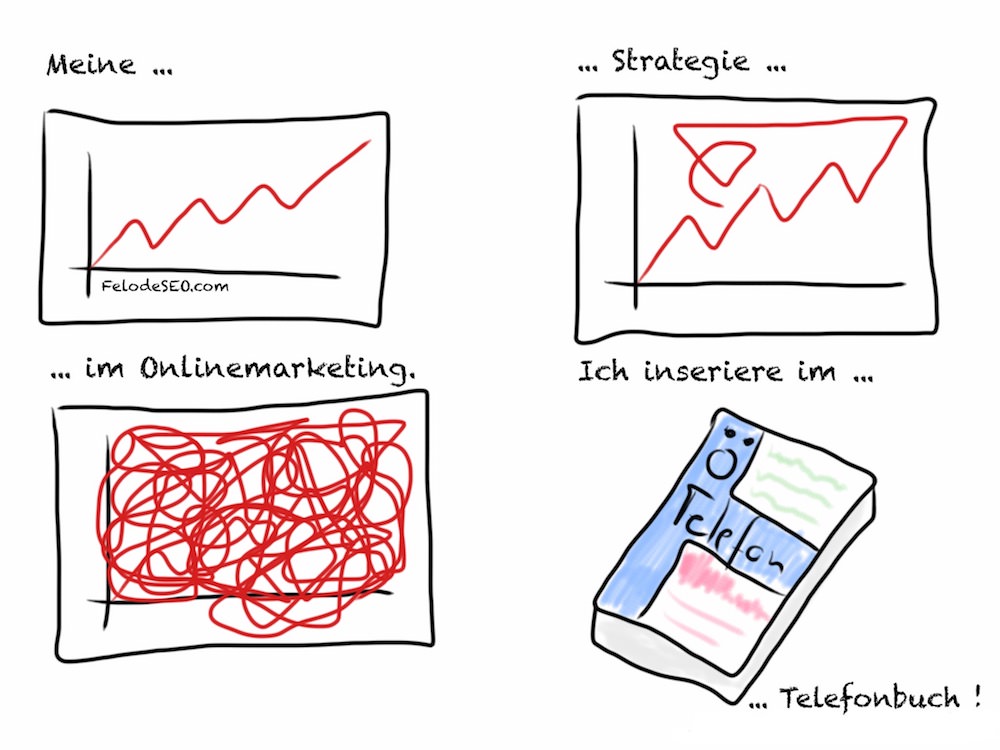 The Right Online Marketing Strategy: ( Translation: My.. ...strategy.. ...in online marketing. I advertise in the... ...phone book